Introducing Evi
Scored Evidence for Customer Discovery
This is a summary of a recent talk I gave at the 2026 Global Consortium of Entrepreneurial Centers (GCEC) conference in Tallahassee. The session kicked off with a lively discussion about what AI is doing to entrepreneurial classrooms and accelerator programs. Just about every instructor in the room resonated with the same problem: the growing difficulty of sorting through the noise in the age of AI. Teams building products instead of doing discovery, inflated claims of validation, hundreds of polished applications that all look the same; everyone agreed it was getting harder to tell who actually did the work. The highlight of the talk was the customer discovery interview grader we developed at NYU to solve that problem for our accelerator programs. To our surprise, it received a strong reaction from our colleagues, and several schools have since reached out about bringing it into their own programs.
The problem: feeding founders vegetables
AI made building cheap. That makes customer discovery more important than ever, and harder than ever to get first-time founders to actually do.
Entrepreneurship classes and accelerator programs ask teams to do customer discovery before they’ve felt the payoff, so many treat it as homework instead of honest investigation. When the deliverable is a number, the number gets inflated. Even teams that commit to doing customer discovery often misread what they hear (what we call “happy ears”), so a coach or instructor has to dig into every conversation before trusting the conclusion every experiment rests on.
Talking to humans is still the foundational activity every startup leader recommends. So instructors have little choice but to keep assigning interviews and keep doing the slow work of verifying them.
In accelerators, that’s a triage problem. Hundreds of teams report big numbers, unverified problems, and polished stories, and it takes hours of staff time to find the ones actually doing the work, learning and solving real customer problems.
Classrooms have the same problem at a smaller scale: surface-level homework, misreported, with AI filling in the gaps. That shaky evidence becomes the foundation for the rest of the semester.
Three questions on every instructor’s mind:
- Did discovery happen?
- Was it done well?
- Did the team take away the right learning?
If there were evidence that could reliably answer these questions with minimal human effort, accelerators and classrooms alike would produce better learning outcomes and better founders.
The insight: the quote is the evidence
Insights earned from customer discovery are still the foundational evidence, but with AI we can change what is counted as the record of it. An interview count is a claim. A summary is the founder’s interpretation.
A verbatim customer line, tied to the transcript it came from, is something a coach or instructor can actually inspect.
So we built a Discovery Records Manager (DRM): a CRM for discovery data, holding every interview transcript and how it scored. At NYU, we’re calling ours Evi, but eventually we envision every startup’s AI stack will have a DRM.
How Evi works
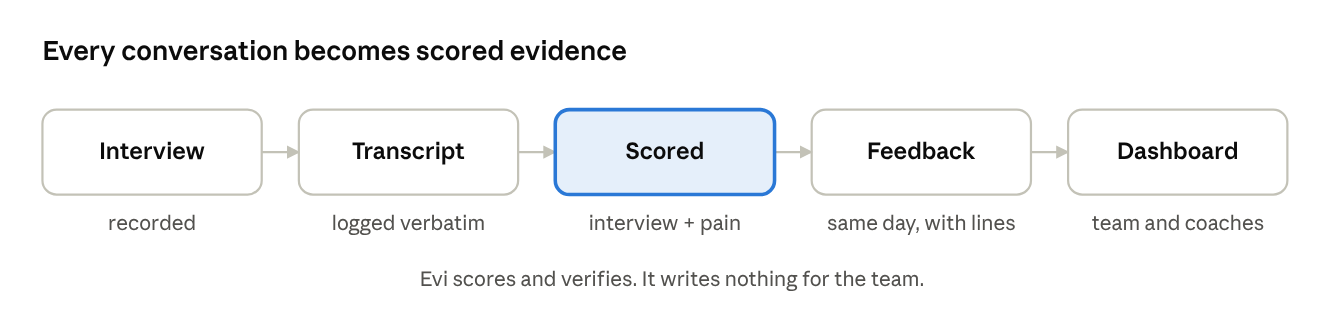
Teams upload interview transcripts (not summaries!). Evi scores each one against two rubrics: how well the interview was run (can we trust this data?) and how strong the customer’s pain is, from “Not a Problem” up to “Hair on Fire” (is this worth building on?). Our rubrics hold years of coaching judgment in detailed criteria, and the model applies that judgment consistently to every transcript.
For years we’ve told students to find a Hair on Fire problem. We finally wrote down exactly what that means, in measurable detail.
We teach the principles behind the rubrics in workshops, but the real learning happens when founders upload an interview and see those principles applied to their own transcript, verbatim. The feedback is private and line by line, without the pressure of presenting in front of a room.
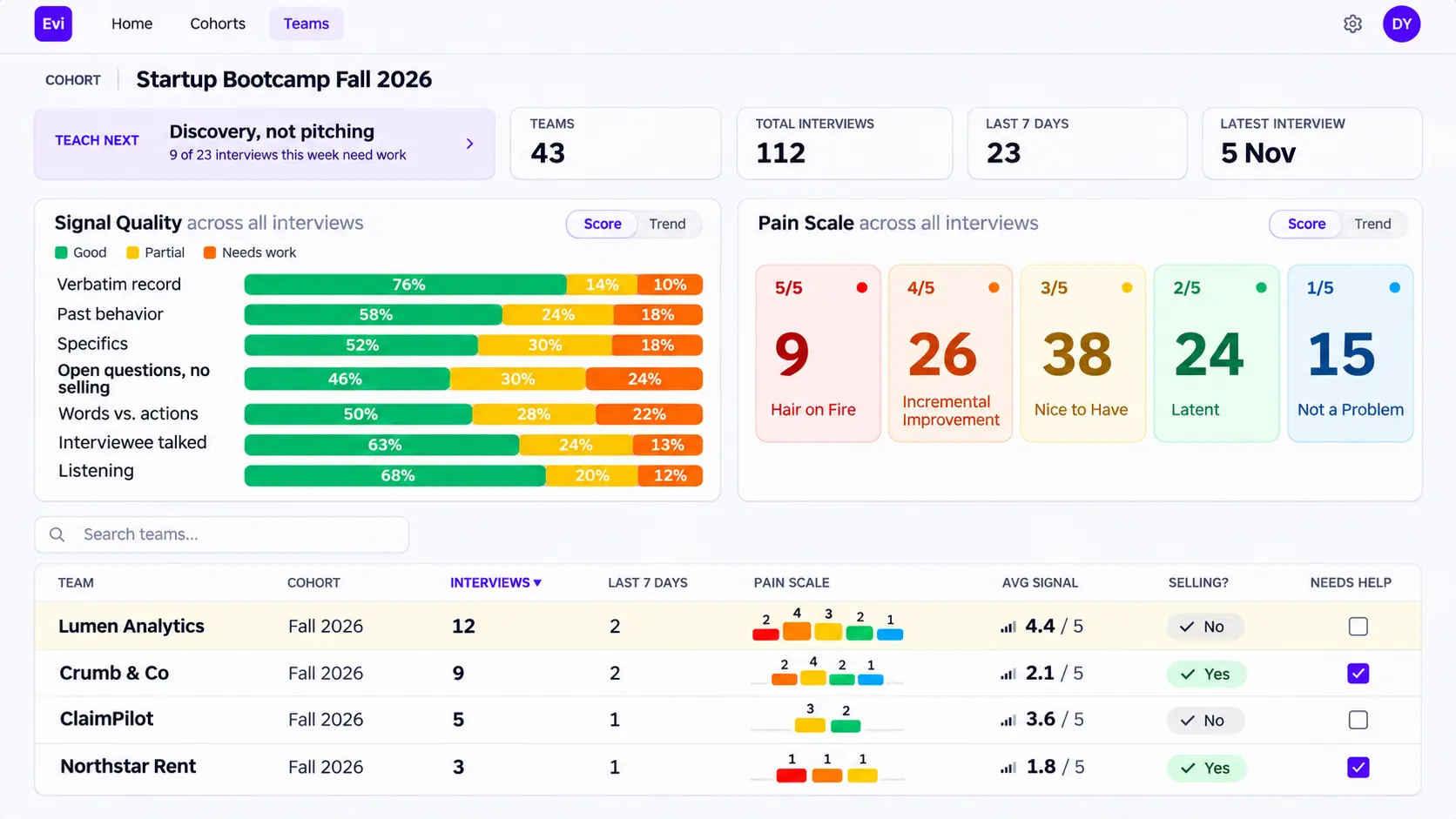
Coaches and instructors get clarity: a dashboard across every team, with verified interviews, specific guidance for improving technique, and cited evidence for each team’s claims about their customer (examples of both views below).
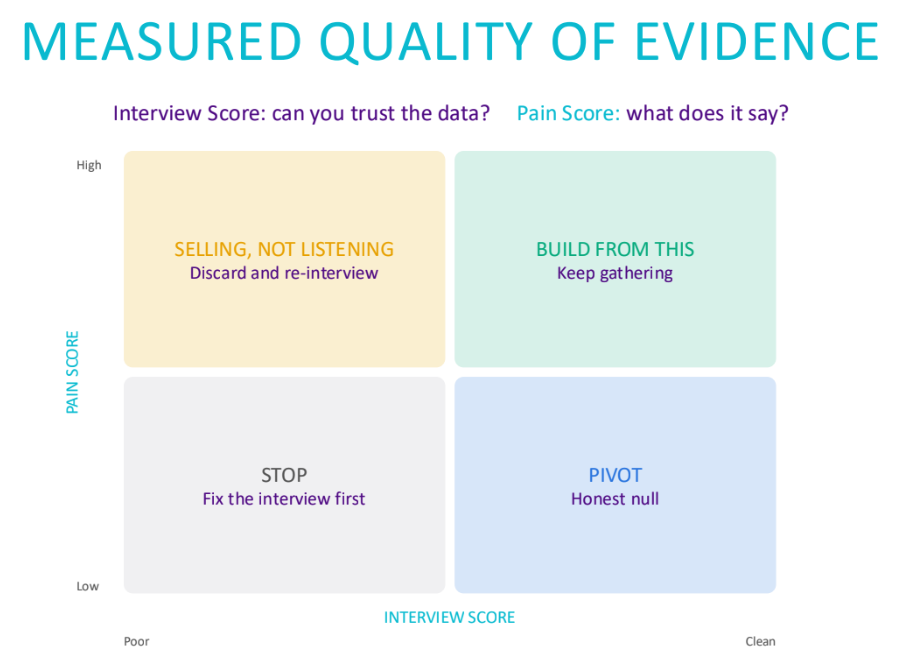
Read together, the interview score and the pain score sort every interview into one of four places: build on it, coach the technique, find a bigger problem, or move on.
The AI’s role is narrow. It doesn’t make decisions for the team, and the evidence is always a real customer’s words. It reads, scores, and verifies (something LLMs are very good at).
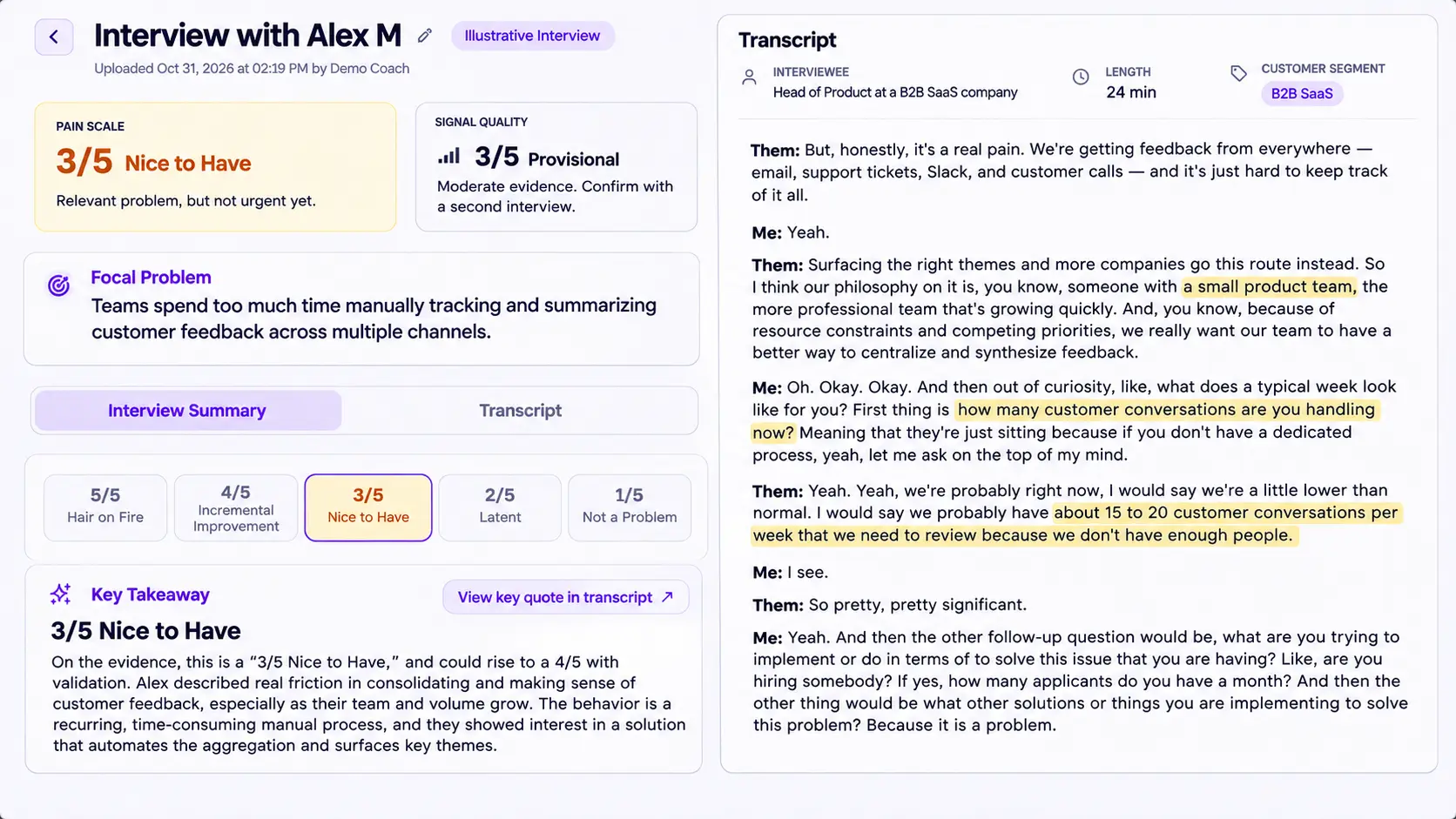
For founders, it’s a fast track to mastering customer discovery and gaining insight into their customers. Founders get precise, meaningful feedback from interview one, a bank of real customer evidence to build on, and a shared record their teammates and coaches can read instead of a secondhand summary.
Enhancing existing curricula and accelerators
Evi plugs into any class or accelerator that already assigns customer discovery interviews. We saw this firsthand when an NYU Stern professor used it to grade her students’ interviews. She found it raised accountability, cut down her investigative work, and improved what the student teams learned.
Best of all, it doesn’t require reworking your curriculum. Most of the interaction happens outside the classroom, and the results reinforce what you’re already teaching, whether that’s Lean LaunchPad, I-Corps, or design thinking.
By adding Evi, any program can benefit from:
- Verified interviews. Know whether a team did the work at all. A transcript exists or it doesn’t.
- Quality of discovery. See who is running the right process. Coaches and instructors know whose findings to trust, and founders see in their own words when they are selling or leading. Teams that are struggling can get coaching aimed at the specific discovery behaviors holding them back.
- Evidence gating. Select on scored evidence instead of reported counts. Teams using Evi in our Startup Bootcamp (600 to 800 teams a year) can now help us assess their interview volume and quality when they apply to our Startup Sprint.
- Smarter coaching. Spend scarce hours where they’ll move something, and run workshops that draw from each team’s logged evidence.
- Metrics that motivate. Unlock resources at milestones, reward top performers, and make discovery social and celebrated.
Early results
We first piloted Evi and the Discovery Ladder at NYU with student startup teams in our two-week Startup Sprint and nine-week Summer Launchpad accelerator programs this past summer.
- In both programs, teams that were new to Evi rethought their problem statements and core assumptions after just 5 interviews.
- Several teams finished the Sprint or Summer Launchpad with zero Hair on Fire customers and still rated the programs 10 of 10. They learned the business wasn’t there and counted that as the win. We did too!
- About a third of teams that were not selected to participate in our Summer Launchpad kept using the tool afterward, unprompted.
- In an early validation check, Evi picked the same top two Summer Launchpad applicants we did after reading every application and interviewing every team.
“It’s a no BS way for me to ground myself in reality, because I know that my biases will always make me overestimate how much pain each person had.”
What’s next
At the NYU Leslie Entrepreneurial Institute we are rolling Evi out across all of our accelerator programs, for both students and faculty/researchers. In the Spring we’ll be using it to triage 200+ startup applications to select for our flagship accelerator programs. We are also making it available to all entrepreneurial classes across multiple NYU schools and colleges.
Evi is the first implementation of the Discovery Ladder, a new framework built on the customer development canon: an evidence-gated customer discovery methodology that uses AI to reinforce best practices. We are redesigning our accelerator curricula to follow the Discovery Ladder and are hard at work on the third iteration as of this writing. For an overview you can read this early explainer on The Discovery Ladder framework.
Development continues on the framework, the program curricula, and the software behind the tool. Be sure to check back regularly for updates on our blog in the coming weeks and months, or sign up for our Entrepreneurship @ NYU newsletter to stay informed as we roll out new features and resources.
Ever since GCEC, there has been growing interest in the framework and the tool from other universities and colleges for both their accelerators and classes. If you would like to join our efforts, please drop me an email at darren.yee@nyu.edu with details on your course or accelerator program.